I have to admit that one of my flaws as a player is that I have a certain elitism where I dismiss games I consider trivial. I think many people would agree with me if I mentioned games like some release from the now-defunct FIFA franchise, the latest soulless entry in Call of Duty, or maybe Fortnite. You know what I mean: THAT kind of game.
It is elitist of me to think of those experiences as lesser. I still believe they fulfill their basic function as video games. They’re fine. They work as games.
Over the past few years, I’ve started putting every friendslop game into this category. I do think they have some merit when they experiment with different forms of multiplayer beyond just skins, looting, and filling the game with microtransactions. They seem designed around whatever streamer happens to be playing them with their friends, hoping the whole thing goes viral. They still fulfill their purpose as games. They’re good games, sure.
Because of that, I’ve played very few of these experiences. The ones I have played have been just okay. It’s one multiplayer game based on another multiplayer game, which refined another multiplayer game, and so on.
My point here is that after playing so many different games that go beyond a single form of play, it’s become almost impossible for me to lower my standards for what I want from a game. There are positives and negatives to that. On one hand, it makes me value games as more than just the sum of their parts. I start looking at them as cultural references. On the other hand, experiences that aren’t trying to be the next big thing in gaming often fall short for me.
I’m aware of that, and it’s a pretty high cost, because there are so many games out there that are just okay but still good games. They’re not revolutionary, sure, but they’re good.
I don’t think this is something that only happens to me. I think a lot of people experience it, and especially in this community, I think many will understand what I mean.
I was so reluctant to play Big Walk, but my friends insisted so much that I eventually said, fine, I guess today we’re playing something that probably won’t give me much beyond having fun.
And here I am, giving the highest possible rating to a multiplayer game that looks like THAT kind of game.
Because just because this game doesn’t have a story doesn’t mean it doesn’t explore a concept or have something to say.
There’s something so human about this game, whether it comes from the way the map is designed, its mechanics being made specifically for it, or its deliberate limitations. Despite all those limitations, we find ways to express our need to be heard and understood.
We do it through our voices, trying to explain some abstract concept with whatever resources we have available, through gestures when we can’t hear each other, or through some lateral way of thinking that turns a problem completely on its head. I believe everything in this game has been deliberately designed so that players can fill in the blanks with whatever concepts, forms, and words they choose.
It’s simply the story of you and your friends hanging out and solving puzzles. That sounds simplistic when you put it that way, but seeing or hearing about it isn’t the same as playing it yourself.
There are games that perfectly gamify other experiences, like driving a car, being a golf ball, or being a slice of bread. The same developers also made a game about being a goose. Mechanically, they work and stay faithful to their ideas.
Here, I feel like the experience itself is the friction of communicating. We all have ideas and different ways of understanding things. Some concepts come more naturally to us than others, and some ways of expressing them are easier for us than others.
I think that’s one of the best things about Big Walk. It doesn’t just use multiplayer as a way to play alongside other people. It uses the limitations of the medium to make communication itself part of the experience.
In the American philosopher Thomas Nagel’s paper What Is It Like to Be a Bat?, he explores the limits of our ability to fully understand the subjective experience of another mind. Even if we knew every objective fact about a being, that wouldn’t mean we could know what it feels like to be that being from its own perspective. Nagel draws a distinction between imagining an experience and actually experiencing it, and points to a fundamental problem for any purely objective explanation of consciousness: knowing how a mind works doesn’t necessarily give us access to what it’s like to live from within it.
To me, Big Walk approaches this problem through the limitations of the tools we have to communicate and how little of another person’s experience we can actually recover from what they manage to express. It turns this very human experience into a game, and that just blows my mind. How had nobody thought of this before?
It ignores the usual trends of multiplayer games and builds its own rules around them, reinventing what we’ve come to expect from similar games. And I don’t think this is just because it found a different way to make puzzles or because it has good mechanics. Everything seems built around this idea of communication.
We all have ideas and different ways of understanding concepts. Some things are easy for us to explain with words, while others need to be represented. Some things we simply don’t know how to communicate.
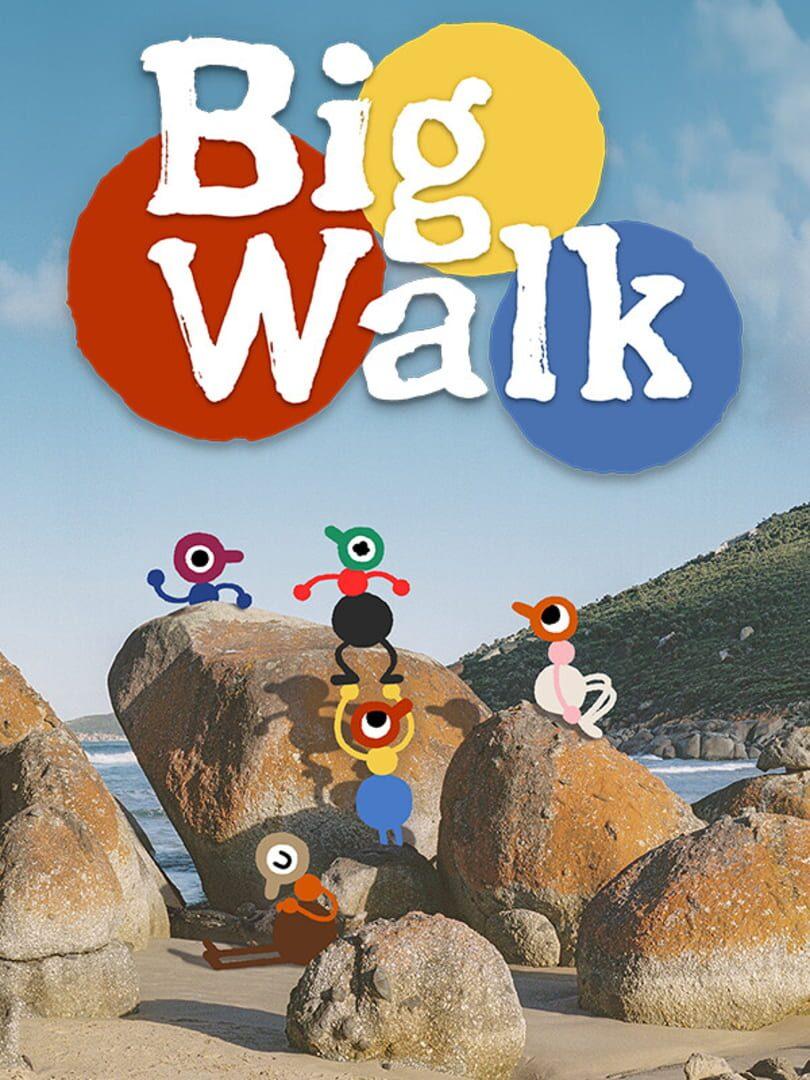
It’s very cute to see these little ball-shaped characters with their flat colors placed in a photorealistic environment. The contrast gives the whole thing its own personality and visual identity. But it doesn’t just capture a nice afternoon with friends. It captures how, in any kind of adversity, our curiosity and our need to communicate leave traces in the world and in other people.
After hours with my friends, I already knew who was good at explaining difficult concepts with words. I knew who was good at using gestures and who tended to think laterally or abstractly.
That’s what made them who they were to me. It gave me this strange sense of closeness, almost as if spending time with them inside the game while walking through these huge landscapes felt too immersive.
And this is where the connection to Nagel becomes even more interesting to me. I never had access to my friends’ actual experiences. I couldn’t see exactly what they were thinking or how they were interpreting each situation. But after spending hours with them, I could recognize the way they thought, the way they solved problems, and the ways they tried to communicate something. I didn’t fully understand their experiences, but I had learned a part of who they were.
My point here isn’t just “great game to play with friends, 10/10.” I really think this game manages to convey so many different feelings through all of its tools, from comfort and community to liminality and even loneliness. And it does all of this without simply putting you around a virtual campfire so you can connect with your friends on Discord and hang out.
When I say that I see some games as art, some people are reluctant to accept it or just don’t get it, and I think this has happened to a lot of us. Many people grew up with games as purely playful experiences, where there was some audiovisual reward for playing them. They had personality, but it didn’t go beyond getting through the levels, and that was it. That’s completely valid. That’s the way they were introduced to games, so that’s how they came to understand them. Or, well, this happens to me a lot: “Yeah, because of the story, music, and aesthetics, right? That’s why it’s art.”
For me, it’s not about how many artistic elements a game has. Yes, it has a distinct visual style, really good music, and, as I said, no story. It’s also multiplayer. But none of that is really the point. What I find interesting is how the game itself becomes the language through which these ideas are expressed. The way you move, the things you can and can’t do, the way you interact with the world and with other players, all of it becomes part of the experience. You’re not simply being told something. You’re put in a situation where you have to experience the idea through the game itself.
The ending of this journey is magnificent. That’s where all the ideas click.
Spoilers · tap to revealSpoilers · tap to hide
Even though we were all indistinguishable from each other, I already knew who was who by the way they behaved, what they did, what they suggested, even without saying a single word. Even without being able to see their perspective or understand it, being able to intuit parts of it after hours of long walks made me realize that I’d taken a part of them with me, their ways, their ideas, things that I’ll probably never completely understand, just as they’ll never completely understand me.
Nothing separates this from real life, where this happens every second we interact with other people. But Big Walk limits it and reinforces it so intensely that it makes one thing very clear: we are what we experience, and the only way to leave something behind from what we see, feel, or think is through one of the most overlooked abilities we have: communicating.
Pros
- Brilliant gameplay and level design
- Great puzzles that always put communication at the core of the experience
- Evokes intimate moments with your friends, when you’re simply walking and talking about life
- The best multiplayer experience of 2026
- Great original soundtrack
Cons
- The host is the only one with a save file for the current run. If you want to explore while a friend is away, you can’t if that friend is the host.